An elementary school PTA veteran observed to me, ?If you want families to come to school, serve food or have their child take part in a performance.? This advice goes for preschool too! ?Serving food makes it easier for families to participate together and seeing their child in action gives families what might be a rare look at what happens at school. Some families can come in at lunchtime?ask them to spend another 15 minutes with their child in the classroom observing the class pet, reading a book aloud, or at a science station.
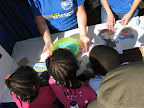 A ?Science Night? or ?Science Saturday? opens a different time slot for the same purpose?to connect families to their child?s education. These social gatherings can be relatively simple, with stations such as leaf rubbings, making a seed sprouting bag to take home, spinning and comparing tops, and building castles on a piece of cardboard that won?t fall over when the ?ground? shakes. Follow up the action with a pizza and fruit dinner or just an ice cream social. The Foundation for Family Science and Engineering has two publications with very detailed lists of how to prepare for a more elaborate Family Science (and/or) Engineering Night, with instructions for activities to challenge older children too. Take a look at Family Science and Family Engineering: An Activity & Event Planning Guide.
Technology allows teachers to share science learning outside of school hours with any family with access to a computer. PreK teacher Gail Laubenthal built a wiki (a website database), titled? Using the Latest Technology to Support Young Children in Science and Math for teachers to share their? work in using technology in?the classroom and to connect to families. Explore the wiki, beginning with the ?Agenda? on the right side, to learn about technologies that you can use. Other teachers use school websites or blogs to connect families to school learning, such as Deborah J. Stewart?s Teach Preschool blog.?
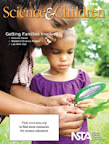 Are you?a?teacher who sends home a science activity for the student to do with family members? The data collected by each student can be put together back in the classroom?to see if there are any patterns, such as, ?How did family members describe the cornstarch and water mixture in the bag?as a liquid or solid?? or ?What happens to light when it falls on a mirrored surface?? Read about an example activity in The Early Years column in the February 2012 Science and Children.
Or explore this list of other resources to find a take-home science activity for your class:
Exploratorium, museum of science, art and human perception, The Science Explorer excerpts
http://www.exploratorium.edu/science_explorer/secret_bells.html
National Science Teachers Association. April 2009. Parent Involvement in Science Learning.
http://www.familyscience.org/pdfs/PositionStatement_ParentInvolvement.pdf
Questacon. Science Play: Play-based science activities for early learners. Australian Government, Department of Innovation, Industry, Science and Research.
http://scienceplay.questacon.edu.au/assets/scienceplay_booklet.pdf
Scientific American. Bring Science Home activities for families
http://www.scientificamerican.com/section.cfm?id=bring-science-home
WGBH Educational Foundation, Family Science and Math letters in English and Spanish
http://www.peepandthebigwideworld.com/guide/pdf/peep-family-letters.pdf
http://www.peepandthebigwideworld.com/guide/pdf/peep-family-letters_es.pdf
WGBH Educational Foundation, Neighborhood Safari
http://www.peepandthebigwideworld.com/printables/pdf/Peep_safari_parentsguide.pdf
WGBH Educational Foundation, Peep in the Big Wide World Explorer?s Guide
http://www.peepandthebigwideworld.com/guide/
Other articles in the February 2012 issue of Science and?Children?are great resources for developing a connection with families:
Science Sacks by Kimberlee Freudenberg and Lab With Dad by Brenda Havers and Karen Delmotte.
I send an email to the families of my students once a week to touch on the work their children did and invite their participation. Send a photograph or two, if you can, to entice the families to?open up and read the email!
Peggy
?

Related posts:
- Connecting with families over the summer
- Importance of teaching science in early childhood promoted by NSTA President Alan McCormack
- Free journal columns on early childhood science
- NAEYC?early childhood and science!
- Handouts about science to share with families?add your favorite resources
Source: http://nstacommunities.org/blog/2012/02/04/involving-families-in-early-childhood-science-education/
san francisco earthquake san francisco earthquake nextdoor premier fitness dan uggla kryptos student loan forgiveness

No comments:
Post a Comment
Note: Only a member of this blog may post a comment.